Showing posts with label Lincoln. Show all posts

Monday, March 24, 2014

Lincoln: Beyond the Myth (Part Four)


In my last semester of college, I completed a writing portfolio entitled "Exploring Modern American Culture through Contemporary Cinema." It contained four essays dissecting four recent films. The third essay examined how Steven Spielberg's Lincoln portrayed the 16th president of the United States. The fourth and final part of that essay is below. I will post a new portfolio excerpt every day. The final essay excerpts will come from my examination of David Fincher's The Social Network (2010). Previous posts: The Dark Knight - Part One, Part Two, Part Three, Part Four; (500) Days of Summer - Part One, Part Two, Part Three, Part Four; Lincoln - Part One, Part Two, Part Three.


 Lincoln: Beyond the Myth

An Accurate Depiction

The usefulness of Lincoln as an educational and inspirational tool for modern audiences hinges on its accuracy. If the real Lincoln was not like the man depicted in the film, if the 13th Amendment was not passed the way the movie shows, then the credibility of the overarching messages would be lost. Fortunately, historians have praised Lincoln for its attention to detail and overall correctness. Of course, some fictionalizing occurred translating history to cinema, with “small historical bloopers” appearing throughout, such as Congressmen voting by state delegation and a portrait of William Henry Harrison hanging in Lincoln’s office (Holzer). Despite these little errors, experts say “virtually every point that the story and script of ‘Lincoln’ makes is grounded in historical fact” (Hertzberg). For example, much of the dialogue was “directly drawn from letters, memoirs, and speeches” from the time period (Hertzberg). This dedication to truth in the making of Lincoln goes beyond the particulars of dialogue. Based on the non-fiction book Team of Rivals: The Political Genius of Abraham Lincoln by Doris Kearns Goodwin, Lincoln tells the true story of the president’s crusade to end slavery. He really did play dirty to get the job done, which is good news for today’s weary Americans. It means political games are not necessarily signs of the democracy’s downfall; there may still be hope for the nation’s leaders.

Conclusion

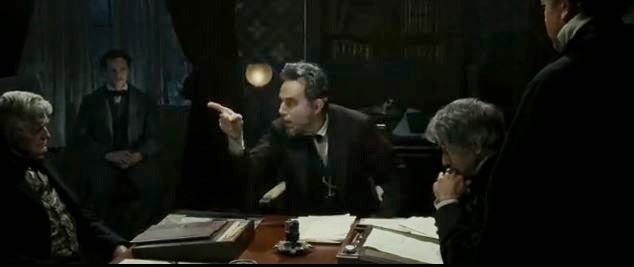
Trying to capture a moment in history is always a tricky venture, particularly when it comes to artistic media. Facts are left out, others are exaggerated, and sometimes obvious falsehoods are included for dramatic purposes. All of these things happen in Steven Spielberg’s Lincoln, but for the most part, it is a historically accurate piece of cinema. After decades of misleading depictions, the film finally presents Lincoln the man – not the myth – to popular culture. His legacy as the Great Emancipator is intact, but his fabricated purity is not. He is shown to be a moral man who is also a careful, determined politician. With his strange, introverted manner, he seems neither like a winning leader nor like the solemn interpretation of Lincoln popular in American culture. He is more than either of those. He is a portrait of the real person, a servant of the people with his eyes set on what is right. But that does not mean he is above crooked scheming. As he shouts at his Cabinet members, he is “the president of the United States of America, clothed in immense power” and he demands their cooperation, whatever that may entail (Spielberg). Perhaps the authentic duality of Spielberg’s Lincoln – the light and dark – can be an illumination for Americans, a sign of hope. Disunity does not have to be permanent, and imperfect leaders can achieve incredible goals.

Sources

Hertzberg, Hendrik. "‘Lincoln’ v. ‘Lincoln.’" New Yorker. 17 Dec 2012: n. page. Web. 2 Nov.2013..

Holzer, Harold. "What's True and False in "Lincoln" Movie." The Daily Beast. The Newsweek Daily Beast Company, 22 Nov 2012. Web. 2 Nov 2013.

Spielberg, Steven, dir. Lincoln. Writ. Tony Kushner, Perf. Daniel Day-Lewis, Sally Field, and Tommy Lee Jones. Touchstone Pictures, 2012. Film. 1 Nov 2013.

Saturday, March 22, 2014

Lincoln: Beyond the Myth (Part Three)


In my last semester of college, I completed a writing portfolio entitled "Exploring Modern American Culture through Contemporary Cinema." It contained four essays dissecting four recent films. The third essay examined how Steven Spielberg's Lincoln portrayed the 16th president of the United States. The third part of that essay is below. I will post a new portfolio excerpt every day. Previous posts: The Dark Knight - Part One, Part Two, Part Three, Part Four; (500) Days of Summer - Part One, Part Two, Part Three, Part Four; Lincoln - Part One, Part Two.


Lincoln: Beyond the Myth

Dirty Politics or Political Prowess?

More controversial than the portrayal of the president’s peculiarities is Lincoln’s depiction of Honest Abe as a crafty statesman. The film shows the passing of the 13th Amendment as being dependent upon unscrupulous practices. Lincoln knows that accomplishing his goal of abolishing slavery will be an uphill battle. There are simply too many people either opposed to the amendment or too afraid to vote “yes.” To procure the necessary votes, Lincoln enlists three lobbyists to bribe Congressmen with the promise of future patronage jobs. This picture of Lincoln as a vote-buyer – getting his hands dirty like so many other politicians in history – may surprise many contemporary viewers who regard him as one of uncontaminated integrity. In addition to this image-shaking depiction of Lincoln, the film shows the president as an assertive leader who is not afraid to push the limits of what he can get away with, if it is for a good cause. Specifically, Lincoln shows him using special wartime powers to move the amendment vote forward, a decision he knows not all his constituents will appreciate. It is a blatant attempt to get the law passed at all costs. He is accused of abusing his position by some, though now, about 150 years later, many ignore or are not even aware of the questionable tactics he used. Some who do know of the 13th Amendment’s true journey do not care, as today it is widely accepted that the end result was worth the unfavorable means (Adkins 212).

The film not only acknowledges Lincoln’s politicking, but respects it, too. Spielberg and screenwriter Tony Kushner do not approach their subject with wagging fingers and harsh reprimands. Lincoln’s perspective on politics is summed up by high-minded abolitionist Thaddeus Stevens (Tommy Lee Jones) when speaking to a fellow Radical Republican. Frustrated by his colleague’s skepticism toward Lincoln, Stevens barks, “Trust? Oh, I’m sorry. I was under the misapprehension your chosen profession was politics” (Spielberg). This is a messy field, and as president, Lincoln is in it deeper than most. He has to make some of the most important decisions in United States history at a time when deep-seated division threatened to tear the country apart forever. He uses his cunning mind and charismatic goodness to do what is right. In the end, “the greatest measure of the 19th century [is] passed by corruption and aided and abetted by the purest man in America,” the legendary Abraham Lincoln (Spielberg).

For modern Americans, this may mean reevaluating the historical figures they use as the gold standard for moral leadership. The film’s portrayal of Abraham Lincoln contradicts the idea that the great leaders of the past were somehow incorruptible and immune to the lion’s den that is Washington, D.C. Even if audiences are not using the past as a means to justify their opinions of the present, it is likely they are feeling cynical about politics. Analysts have noticed a trend toward distrust of or apathy toward the political process. According to Trey Garson, director of the Institute of Politics at Harvard University, the focus on “petty partisan politics” instead of “big issues” has led to disenchantment with the government, particularly among Millennials (Stolberg). If Lincoln is treated as a document of history, it could serve as a source of hope for a disillusioned public. The era depicted in the movie is one with arguably the greatest disunity the United States has ever known. As shown in Lincoln, the North and South were at war, and Northerners were at odds over how to bring the nation back together. If Abraham Lincoln, an honorable man and skillful politician, could help lead the U.S. through that time, perhaps it is possible for someone today to help the nation through these far less dire but nonetheless divided times.

Sources

Adkins, Jason A. "Lincoln's Constitution Revisited." Northern Kentucky Law Review. 36.2 (2009): 211-50. Print.

Spielberg, Steven, dir. Lincoln. Writ. Tony Kushner, Perf. Daniel Day-Lewis, Sally Field, and Tommy Lee Jones. Touchstone Pictures, 2012. Film. 1 Nov 2013.
Stolberg, Sheryl Gay. "For ‘Millennials,’ a Tide of Cynicism and a Partisan Gap." New York Times 29 April 2013, n. pag. Web. 2 Nov. 2013.

Thursday, March 20, 2014

Lincoln: Beyond the Myth (Part Two)


In my last semester of college, I completed a writing portfolio entitled "Exploring Modern American Culture through Contemporary Cinema." It contained four essays dissecting four recent films. The third essay examined how Steven Spielberg's Lincoln portrayed the 16th president of the United States. The second part of that essay is below. I will post a new portfolio excerpt every day. Previous posts: The Dark Knight - Part One, Part Two, Part Three, Part Four; (500) Days of Summer - Part One, Part Two, Part Three, Part Four; Lincoln - Part One.


Lincoln: Beyond the Myth

An Unusual Leader

Lincoln begins in routine historical film fashion: a somber Civil War battle rages on, showing the horrific nature of the war. But expectations begin to be subverted, ever so slightly, once the battle ends. The president casually converses with two black soldiers at a Union Army camp. He listens to everything they have to say, which is mostly respectful, occasionally critical speech. One objects to the economic and legal inequality between black and white soldiers; Lincoln neither dismisses the issue nor provides a solution or words of encouragement. The group is later joined by two white soldiers, who pour out their admiration for the president. Despite the peculiarity of its nonchalance, this moment retains the idealizing worshipfulness common in portrayals of Lincoln. These soldiers admire their leader greatly – so much so that they have memorized the Gettysburg Address, which they quote to him. Though his weaknesses are hinted at in his lack of response to the black soldier, in this scene, Lincoln is more than a man. He is an idol.

As the film progresses, Lincoln’s eccentricity becomes more evident. He is a man of great intrigue and eloquence, but not in the way that is generally expected of leaders. He does not spend the movie jovially shaking hands and kissing babies, nor does he fit the stern “Saint Abraham” image Americans might have in their minds (Wilentz 29). Instead, Spielberg’s film presents a man who was a virtuoso politician in his own unique way. His Lincoln is an introverted, intellectual man who cannot and will not pretend to be anything else. He often annoys and bewitches his Cabinet members by interjecting sometimes long, obscure stories and quotes during their political debates. Lincoln tells metaphorical tales with quiet charisma and purpose. His tangents are never meaningless. For example, he interrupts an argument with his Secretary of War, Edwin M. Stanton (David Strathairn), about pushing for the 13th Amendment over ending the war. After an exasperated Stanton declares “it’s a disaster,” Lincoln says “time is a great thickener of things” (Spielberg). At first Stanton agrees; then he admits he has no idea what the president is talking about. It is not that Lincoln is actually speaking nonsense. He is trying to convey, in his own way, that the 13th Amendment may cause immediate political problems, but time will show its importance and righteousness.

This behavior is common with Spielberg’s Lincoln. His conduct is not what modern Americans expect from any great politician, and especially not from the venerated Lincoln. There is nothing inherently wrong with Lincoln’s cryptic manner, but it is certainly unusual. When one thinks of a revered president, does he or she think of a bookish man who casually quotes Shakespeare and confounds even his closest political allies? Probably not. To add to this, Lincoln is not all that serious either. He is dedicated when it comes to serving the nation and promoting equality, but he is not averse to telling jokes and even swearing now and then. These personality quirks alone could shatter one’s perception of Abraham Lincoln. They bring him down to earth from his lofty historical pedestal. Lincoln still shows him as an extraordinary man, but not the solemn figure of American lore, and definitely not the type of outgoing politician favored by society today.

Sources

Spielberg, Steven, dir. Lincoln. Writ. Tony Kushner, Perf. Daniel Day-Lewis, Sally Field, and Tommy Lee Jones. Touchstone Pictures, 2012. Film. 1 Nov 2013.

Wilentz, Sean. "The Lost Cause and the Won Cause: Abraham Lincoln in politics and the
movies." New Republic. 31 Dec 2012: 28-34. Print.